Written by Meg MacKenzie, Language Disorder Australia.
Every day, we use supports without giving them much thought. We write lists, turn on captions, adjust the brightness of a screen, use predictive text when texting, turn off the music in the car before turning right at an intersection, move to a quieter room or ask someone to repeat an instruction. All effective ways of understanding what we need and shaping our environment so that we can thrive in what we do.
Self-advocacy is often imagined as a confident student independently approaching a teacher and clearly explaining what they need. In reality, this is the end point of a much longer learning process.
Before students can ask for support, they need opportunities to understand themselves. They need language to describe their experiences and voice their preferences, knowledge of the supports available to them and confidence that adults will listen when they communicate a need. For many students, including those with Language Disorder or language difficulties, this process often requires explicit teaching, accessible tools and support from trusted adults around them.
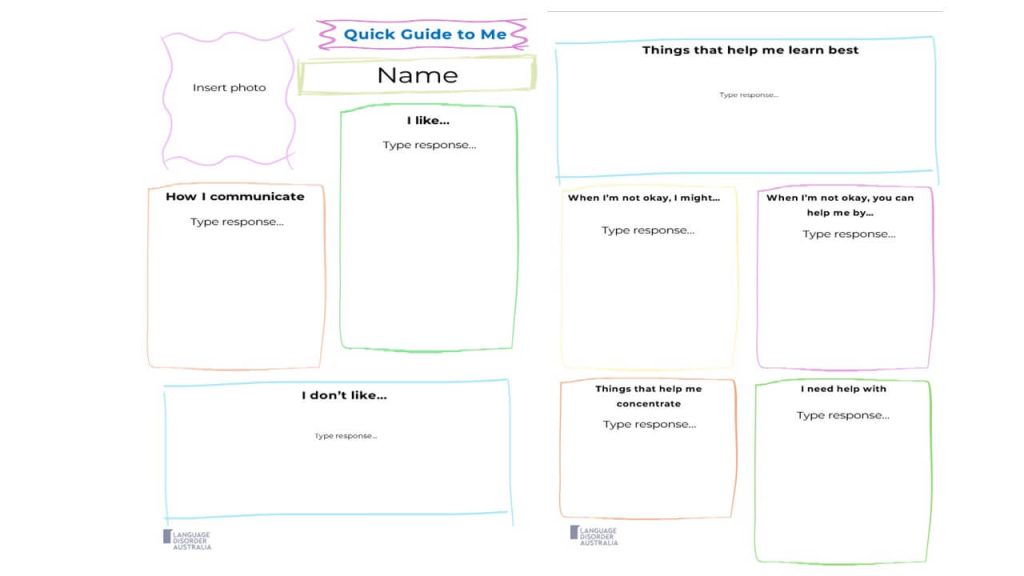
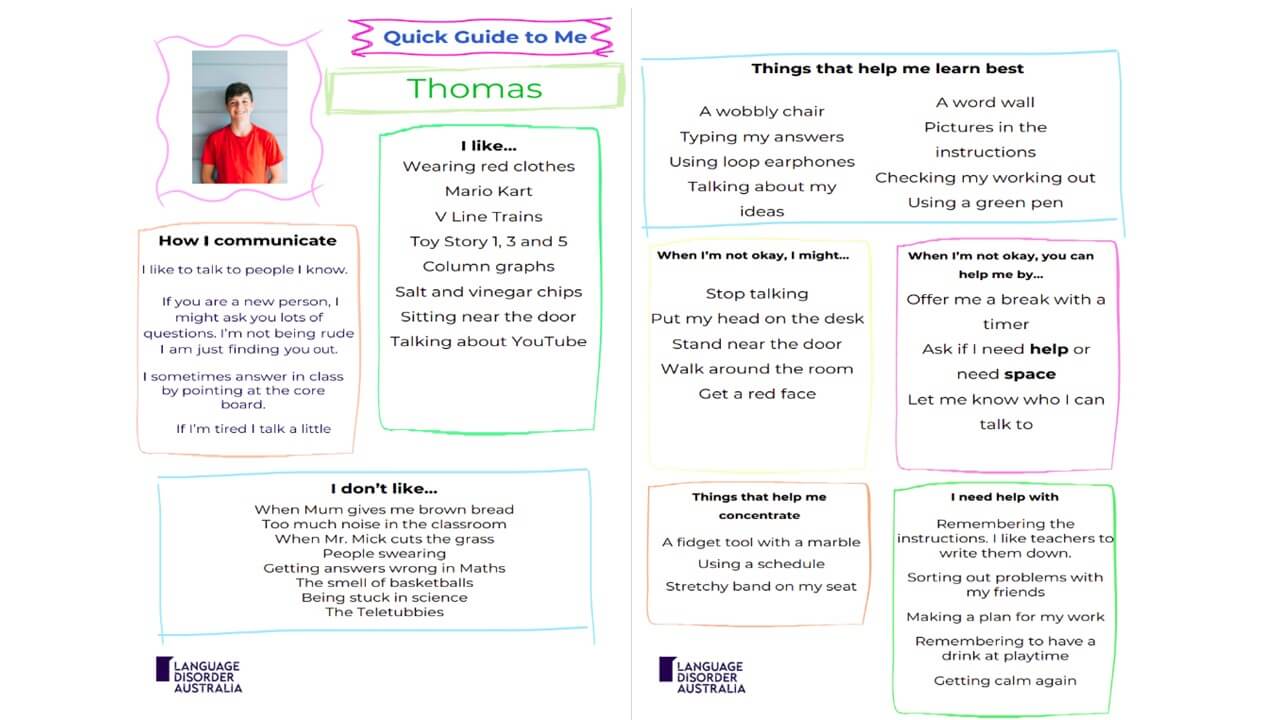
Language Disorder Australia resource ‘A Quick Guide to Me’ has been designed to support this process. It provides a structured way for students and school staff to identify, document and share the student’s strengths, preferences, communication needs and effective supports.
Self-advocacy is a team sport.
Students do not know what they do not know. A student should never have to advocate perfectly before receiving support. Some students will not yet recognise that they are confused, overwhelmed or fatigued. Others may know that something is wrong but are unable to explain it. A student who says, “I can’t do it,” might actually mean, “I understand the maths, but I lose the steps when the instructions are only spoken.” The challenge for educators is that learning difficulties, cognitive load and communication barriers are not always visible. When we rely solely on students to identify, articulate and justify their needs, we risk overlooking those who are least able to do so. Effective support begins with curiosity, observation and a willingness to consider what may sit beneath the words a student is able to express.
This is particularly important for students with Language Disorder or other language and communication differences. Self-advocacy is a language-dense task. Students may need to understand complex information about choices and expectations, identify the barrier, explain its impact, request a suitable adjustment and repair the conversation if they have been misunderstood. Difficulties with vocabulary, sentence structure, comprehension, social communication or organising a connected message can affect every stage of this process.
Therefore, “just ask for help” is not an adequate strategy. Education staff remain responsible for proactively providing accessible instruction and reasonable adjustments, while teaching students how to increasingly participate in decisions about their support.
Self-advocacy is a communication activity, but not only a communication skill.
Although communication is a crucial component for successfully self-advocacy, it is not a communication skill alone. Research frameworks also identify knowledge of self, knowledge of rights and available options, decision-making and problem-solving, and the ability to act, persist and review whether support was effective as important components of successful self-advocacy.
A Quick Guide to Me provides a practical starting point for these conversations. When completed collaboratively, revisited regularly and used responsively, it can help transform student voice from a once-a-year activity into an everyday part of teaching and learning. The resource should not be completed about a student without their meaningful involvement. Its purpose is to capture the student’s perspective, not simply to record adult observations.
Students may need something to choose from.
Students cannot identify a preferred support if they have never experienced different options. Asking, “What helps you learn?” may result in “I don’t know”.
Before completing the guide, staff should explicitly introduce and trial relevant supports. These might include written instructions, visuals, worked examples, movement breaks, sensory tools, assistive technology, flexible seating, additional time, reduced language load or opportunities to respond in different ways.
The accompanying guidance recommends teaching students how to use available classroom supports, allowing them to trial these across different situations and returning to the profile once they have had time to consider what works.
This process is important because a support that appears suitable to an adult may not be useful to the student. Consider noise cancelling headphones. These can be an extremely effective option for students who are impacted by auditory stimuli. However, if they do not like the feel of them, or are embarrassed to wear them, are they still an effective and reasonable adjustment? Probably not.
Listen when students use their voice.
The most important response to self-advocacy is not a worksheet, script or program. It is an adult who listens.
When a student communicates that a support is unhelpful, uncomfortable or no longer effective, take that information seriously. Ask questions, clarify the barrier and explore alternatives together. Students are the experts in their own experience, even if they need some support using language to describe it.
A Quick Guide to Me provides a practical starting point for these conversations. When completed collaboratively, revisited regularly and used responsively, it can help transform student voice from a once-a-year activity into an everyday part of teaching and learning.
Most importantly, when students tell us what helps, we must be prepared to listen, take their experiences seriously and act alongside them