
Written by Thuy Pham, Spectrum Books.
The Learning Staircase
Every school has that teacher.
The one everyone sends students to when fractions just aren’t making sense. Or the teacher who somehow turns reluctant writers into confident ones. Or the colleague who always seems to know exactly what to say when a learner is on the verge of giving up.
If you’ve worked in schools for long enough, you can probably picture them already.
The interesting thing is that these teachers rarely describe what they do as anything remarkable. If you ask them why something worked, they’ll often shrug and say they just tried something different. They don’t always realise that what looks like instinct is usually the result of years spent noticing patterns that other people haven’t seen yet.
Over time, every experienced teacher builds an extraordinary body of knowledge. They discover better explanations, refine lesson sequences, recognise misconceptions earlier and gradually develop an instinct for knowing when a learner needs another example, another question or another opportunity to practise before moving on. Most of those discoveries happen in ordinary classrooms on ordinary days. They aren’t the result of a new initiative or a professional learning workshop. They’re built lesson by lesson, learner by learner.
That made me wonder something.
What happens to everything those teachers learn?
Every Teacher Builds Ladders
The question stayed with me until one afternoon I found myself imagining a school without a staircase.
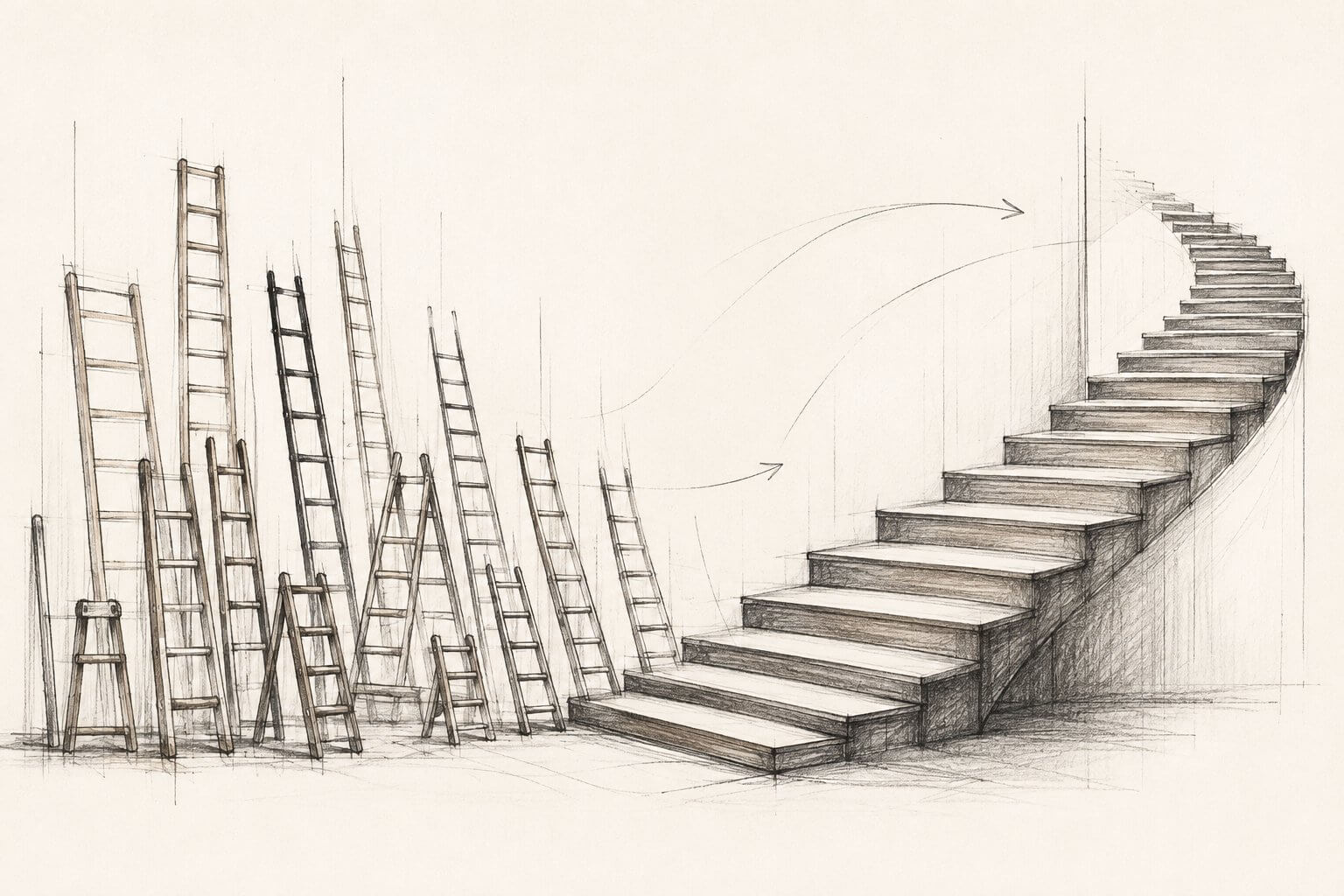
Every classroom was on the second floor, so the only way to help learners reach them was with ladders. Every teacher built their own.
At first it seemed like a strange image. Then the more I thought about it, the more familiar it became.
Every rung represented something a teacher had learnt through experience. A better explanation for fractions. A worked example that consistently uncovered a misconception. A routine that helped learners become more independent. The longer someone taught, the more ladders they built and the more instinctively they knew which one a learner needed.
That’s what expertise looks like. It isn’t something teachers download from a textbook. It’s something they build, one learner at a time.
Then I realised something I hadn’t seen before.
The problem wasn’t that teachers were building ladders.
It was that the ladders belonged to the people who built them.
Schools Are Built to Forget
When an experienced teacher retires, changes schools or even moves to another year level, those ladders often go with them. The following year another teacher walks into the classroom, meets a learner standing in almost exactly the same place on their learning journey and begins building many of the same ladders all over again. Not because they aren’t capable.
Because no one handed them the ladders the school had already built.
That’s when I stopped thinking about teacher workload and started thinking about organisational memory.
Schools often describe themselves as learning organisations, yet much of what they learn remains inside individual classrooms instead of becoming part of the organisation itself. New teachers inherit curriculum documents, assessment schedules and school policies, but very little of the accumulated wisdom about learning that experienced teachers have spent years developing.
The school has already solved many of these problems. It just hasn’t found a way to remember the solutions.
Another Way of Thinking
Around the same time, I noticed another conversation taking place across education.
Some schools were asking teachers to build the ladder through explicit instruction. Others were asking learners to build their own through inquiry. What interested me wasn’t deciding which approach was right. It was realising that both approaches were answering the same question.
Who should build the pathway?
Very few people seemed to be asking a different question altogether.
What if the pathway itself had already been designed?
The Learning Staircase
The more I sat with the image, the more I realised I wasn’t imagining a better ladder.
I was imagining a staircase.
Not one designed by a consultant or purchased as a program, but one built gradually by generations of teachers who kept noticing patterns and refused to let those discoveries disappear.
Every teacher contributed something. A better sequence. A clearer explanation. A question that consistently unlocked understanding. A routine that helped learners become more independent. On their own, those discoveries seemed small. Together they became something much larger than any individual teacher could build.
A Learning Staircase captures those discoveries and makes them part of the school’s learning architecture. New teachers don’t inherit somebody else’s script. They inherit the school’s accumulated wisdom, then contribute their own. No one has to begin where someone else once began.
That’s how schools become wiser.
From Philosophy to Practice
Looking back, I don’t think Spectrum Books began as a publishing company.
It began with a question.
What would happen if schools could remember what their teachers had already learnt?
At the time, I would have said we were creating curriculum resources. Looking back, I think we were doing something different. Every lesson sequence, worked example, reflection and opportunity for independent practice became another attempt to preserve something that had previously lived inside one teacher’s experience.
Seen that way, curriculum resources aren’t simply things students use. At their best, they’re one of the ways a school preserves what it has learnt about learning.
That’s what Spectrum Books has become for us.
Not simply a collection of books.
An attempt to build a Learning Staircase.
Learning to See
Building the staircase led to one final question.
If every school has a learning architecture, how would we know whether it was strong?
We already measure attendance, assessment, engagement and wellbeing. Those measures all matter, but they tell us about the results of a learning system rather than the strength of the system itself.
Before we can strengthen a learning system, we first need a way of seeing it.
That question eventually led to the development of the Pentaverse Scale, a measurement instrument designed to examine the structural quality of learning systems. Earlier this year, two independent university research teams used the instrument to examine 200 education systems and learning platforms from around the world.
What interested me most wasn’t which systems scored highest.
It was discovering where the wisdom lived.
In some systems, much of what teachers had learnt had become part of the architecture itself. In others, teachers were still carrying much of that knowledge individually, rebuilding parts of the learning journey every year.
Every system cared deeply about learners.
The difference was whether the system had learnt from its own experience.
Where to From Here?
One of the reasons I wanted to share this idea is that I think schools already contain extraordinary wisdom.
Walk into any staffroom and you’ll find teachers who have spent years learning how to explain difficult ideas, rebuild confidence, recognise misconceptions and help learners become more independent. The challenge isn’t creating more wisdom.
It’s making sure that wisdom outlives the individual classroom.
That’s what a Learning Staircase has come to mean for me.
It’s the collective memory of a school made visible.
I’ll be exploring this idea further at the National Education Summit on 3 September, where I’ll introduce the Pentaverse Scale and invite school leaders to examine the strength of their own learning architecture. If you’ve ever wondered whether your school is building ladders or a staircase, I’d love to continue the conversation there in the Knowledge Centre at 1:45pm.