Written by Melissa Lozanovski, Founding Director, Bien Collective
There are moments in our lives that stay with us long after the details have faded. Moments that quietly shape who we become and influence the decisions we make years later.
For me, one of those moments was losing my principal.
At the time, I was still developing as a leader. Like many educators, I was immersed in the everyday busyness of school life, supporting students, working alongside colleagues and trying to make a positive difference wherever I could. Our principal was someone I respected deeply. He cared enormously about the school community and worked tirelessly to create opportunities for others. He was the kind of leader who always seemed to put the needs of everyone else before his own.
When he lost his battle with mental health, our community was devastated.
In the weeks and months that followed, I found myself reflecting on leadership in a way I never had before. I couldn’t stop wondering how someone who was so committed to others could become so overwhelmed. More importantly, I began questioning the stories we tell ourselves in education about what it means to be dedicated.
Somewhere along the way, many of us have come to believe that good educators always give more. We stay later, take on extra responsibilities, respond to emails after hours and continue pushing through when we are exhausted because there is always another student to support, another family to contact or another challenge to solve.
The work we do matters deeply, and perhaps that is part of the problem. When something matters to us, it becomes easy to convince ourselves that our own needs can wait.
Years later, when I became a principal myself, those reflections remained close to my heart. They influenced the way I led, the conversations I had with staff and the way I thought about wellbeing. I had seen firsthand what can happen when caring for others consistently comes at the expense of caring for ourselves.
What I have learned since is that wellbeing is often misunderstood in schools. We frequently talk about it as though it is another initiative to implement or another program to add to an already crowded agenda. Yet the most significant influences on wellbeing are rarely found in formal programs. More often, they are found in the everyday moments that shape the culture of a workplace.
They are found in the way leaders respond when mistakes are made. They are found in whether staff feel safe to ask for help. They are found in the expectations we place on ourselves and others, and in the behaviours we model each day without even realising it.
Research describes this in different ways. We know that emotions are contagious and that the way one person shows up can influence the experience of those around them. We know that psychologically safe workplaces enable people to contribute more openly, collaborate more effectively and seek support when they need it. We also know that self-compassion plays a significant role in protecting wellbeing and reducing burnout.
What interests me most, however, is how these ideas intersect in our daily lives as educators.
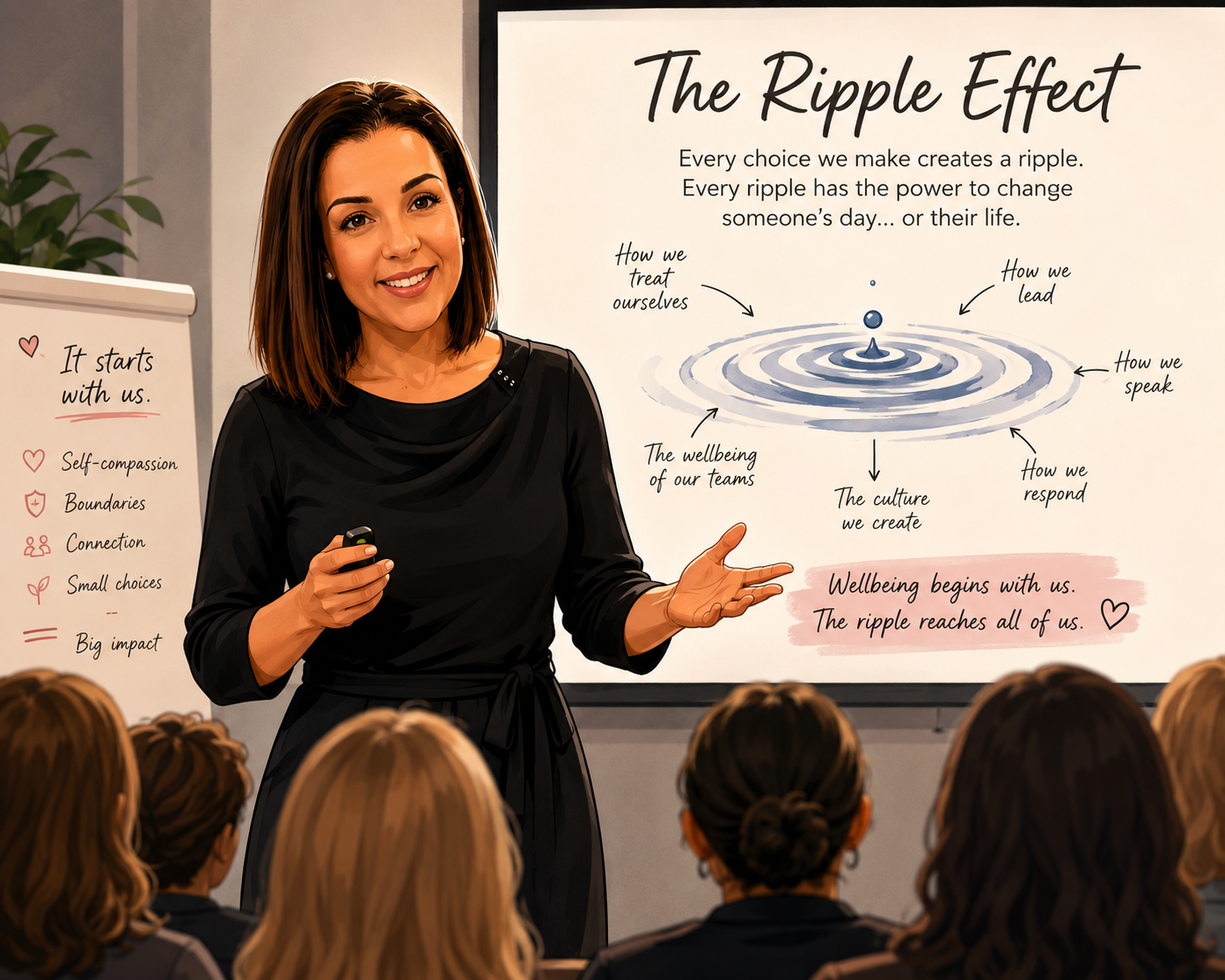
Every day, whether we realise it or not, we create ripple effects.
When a leader sends emails late into the evening, it sends a message about expectations. When a teacher speaks kindly to themselves after a difficult lesson instead of engaging in harsh self-criticism, it models a different way of responding to challenge. When a colleague chooses vulnerability and admits they are struggling, it often gives others permission to do the same.
These moments may seem insignificant in isolation, yet collectively they shape the emotional climate of our schools.
Looking back now, I often think about the legacy my principal left behind. His loss taught me many things, but perhaps the most important lesson was that wellbeing cannot remain an afterthought. It cannot be something we promise ourselves we will focus on once everything else is finished because, in education, everything else is never finished.
Instead, wellbeing needs to become part of how we work, lead and live.
It begins with recognising that we are human before we are educators. It begins with extending the same compassion to ourselves that we so freely offer to students, colleagues and families. It begins with understanding that looking after ourselves is not selfish; it is one of the most important contributions we can make to the communities we serve.
The challenges facing education are complex, and there are no simple solutions. Yet I remain hopeful because I have seen the power of small changes. I have seen what happens when leaders model healthy boundaries, when teams prioritise connection and when educators give themselves permission to be imperfect.
The ripple effect of those choices reaches further than we often realise.
Perhaps that is where meaningful change begins—not with a grand gesture or a new initiative, but with one person making a different choice and allowing that choice to influence those around them.
After all, wellbeing does not begin with a program.
It begins with us.