
Written by Classroom Companion.
Across Australian classrooms, educators are being asked to respond to increasingly complex student needs while doing the job they entered the profession to do: teach.
A student refuses to begin their work. Another leaves the classroom. A seemingly minor interaction escalates unexpectedly. A student who rarely causes concern quietly withdraws.
In the moment, educators respond. They redirect, regulate, de-escalate, document, communicate and then continue teaching.
Tomorrow, they may do it all again.
But what if we could better understand what happens before these moments?
What if behaviour was not simply something to respond to, but information that could help us understand what a student needs?
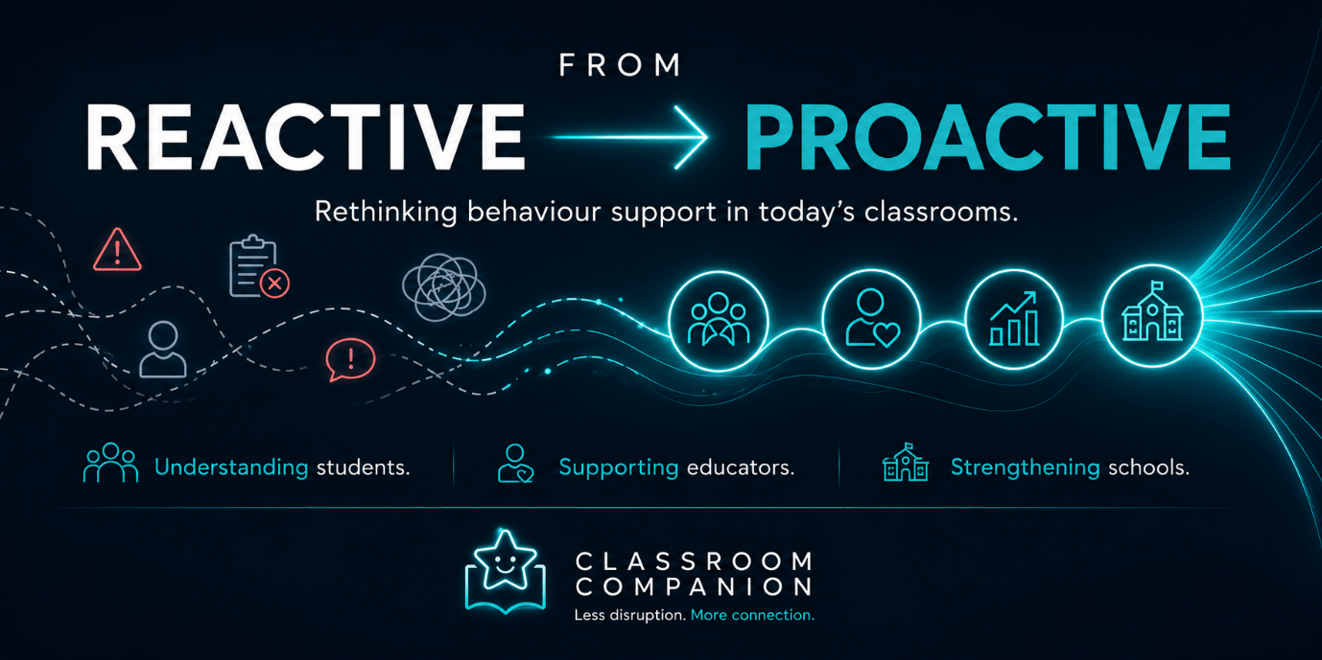
That shift—from reacting to understanding—is where proactive behaviour support begins.
Behaviour rarely exists in isolation
An individual incident can tell us what happened.
Patterns can begin to tell us why.
A behaviour that appears unpredictable when viewed on its own may look very different when considered alongside the environment, time of day, task, preceding events, student needs and strategies previously used.
Perhaps escalation consistently occurs during transitions.
Perhaps a particular learning demand is creating frustration.
Perhaps behaviour changes at a certain time of day.
Perhaps an intervention works extremely well for one student but repeatedly has little impact for another.
Or perhaps the student who appears compliant and causes no disruption is quietly struggling without attracting anyone’s attention.
Educators often hold pieces of this information already.
The difficulty is connecting them.
The challenge isn’t a lack of care
Teachers know their students.
They notice changes in mood, engagement, behaviour and relationships. They remember conversations from the playground, information shared by families and strategies suggested by support teams.
But educators are also managing classrooms, curriculum, assessment, administration, communication and the needs of many individual students.
Expecting one person to continually collect, remember and analyse every interaction places an enormous cognitive burden on educators.
And when information sits across incident reports, teacher notes, emails, conversations and different systems, patterns can be difficult to see.
This is where schools have an opportunity to move beyond simply recording behaviour and begin using the information they already collect to support better decisions.
From recording incidents to understanding patterns
For many schools, behaviour documentation has traditionally been retrospective.
Something happens.
It is recorded.
An action is taken.
The process is important, particularly for accountability and student safety. But recording what happened should be the beginning of the conversation—not necessarily the end.
Imagine instead being able to ask:
- What was happening before this behaviour occurred?
- Have we seen this pattern before?
- Which strategies have been tried?
- What has actually worked?
- Are there environmental, relational or learning factors we should consider?
- Is something changing that warrants earlier support?
These questions move the focus from simply managing incidents toward understanding students.
And understanding creates opportunities for earlier intervention.
Proactive doesn’t mean predicting children
Students are individuals, and behaviour is complex.
Moving toward proactive support isn’t about trying to predict exactly what a child will do next.
It is about giving educators better information so they can recognise patterns, identify emerging needs and make informed decisions earlier.
That distinction matters.
Technology should never replace professional judgement or the relationships educators build with students.
It should strengthen them.
The most useful technology in education should help reduce the noise around educators so they have more capacity for the human part of education: teaching, connecting, noticing and supporting.
Consistency matters
One of the greatest opportunities in behaviour support is also one of the simplest: consistency.
A student may interact with classroom teachers, specialist teachers, teacher aides, wellbeing staff, inclusion teams and school leaders throughout a week.
Each adult may see something slightly different.
When those observations remain isolated, schools see fragments.
When they are brought together, a clearer picture can emerge.
That shared understanding can also help educators respond more consistently.
Instead of beginning again each time a student enters another classroom or works with another staff member, educators can build upon what has already been learned.
What helps this student regulate?
What tends to increase difficulty?
Which approaches have been successful?
What should we avoid repeating when evidence tells us it isn’t working?
That is where information becomes genuinely useful.
Understanding students. Supporting educators. Strengthening schools.
Classroom Companion was created around these three ideas.
Understanding students.
Looking beyond isolated incidents to identify patterns, triggers, needs and changes over time.
Supporting educators.
Giving teachers practical, evidence-informed insights and strategies without expecting them to manually connect every piece of information themselves.
Strengthening schools.
Creating a more consistent picture across classrooms, educators and support teams so decisions can be informed by shared understanding rather than isolated observations.
Classroom Companion is a behaviour intelligence platform designed to help schools move from reactive behaviour management towards proactive student support.
It brings together incident information, triggers, interventions and outcomes to help educators recognise patterns and understand what may be influencing a student’s behaviour.
Importantly, the goal isn’t more data for the sake of data.
The goal is useful insight.
Insight that can inform a conversation.
Insight that can help an educator try something differently.
Insight that may allow a school to recognise a pattern earlier.
And ultimately, insight that creates more opportunity for connection.
Less disruption. More connection.
When we talk about reducing disruption in classrooms, it can be tempting to focus solely on stopping behaviour.
But sustainable change often starts somewhere else.
With curiosity.
With understanding.
With asking why before deciding what next.
Because behind every incident is a student.
And beside that student is an educator trying to make the best decision they can with the information available to them.
If we can make that information clearer, more connected and more useful, we can give educators something incredibly valuable:
The opportunity to respond earlier, more consistently and with greater confidence.
That is the shift from reactive to proactive.
And it has the potential to create classrooms with less disruption, stronger relationships and more time for what matters most—teaching and learning.